
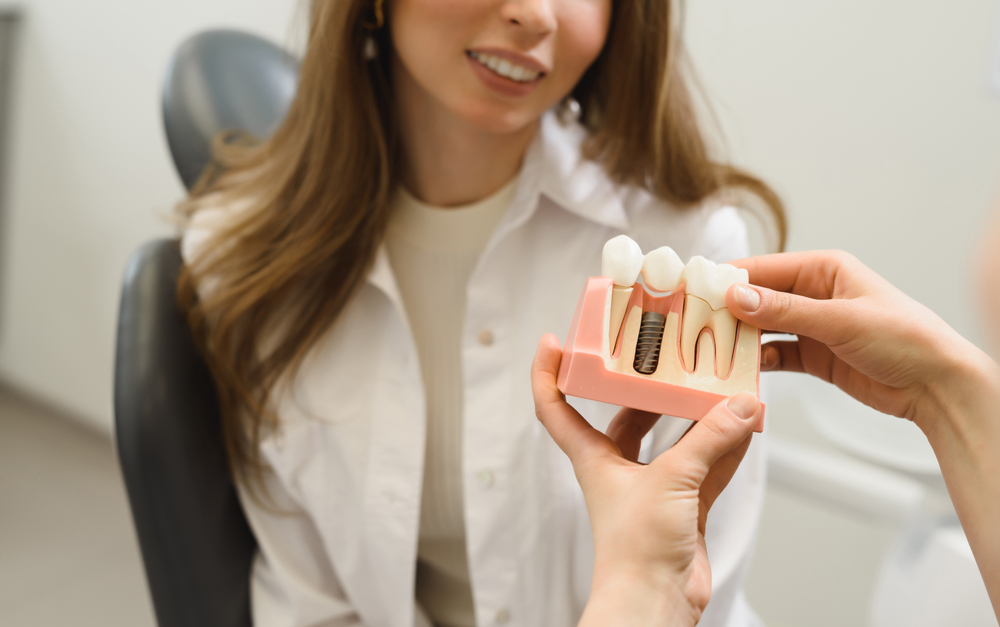
Dental implants Mission Valley patients trust start with Salt and Smile Dental Co. Instead of resting on the gum tissue, an implant is a titanium post placed into the jawbone itself, where healing over several months locks it into position so it can support a crown, bridge, or denture from underneath, much like a natural tooth root once did. Dr. Shawn Yazdanmehr personally oversees each visit, from your first exam through the day your new tooth is finished, keeping your treatment under one roof from start to end.
Dental Implants Mission Valley

Meet Dr. Yazdanmehr
Growing up in Carlsbad and studying pre-dentistry at UCLA set the foundation for Dr. Shawn Yazdanmehr’s dental career, which continued at the University of the Pacific, Arthur A. Dugoni School of Dentistry. Before opening Salt and Smile Dental Co. in San Diego, he spent several years building his surgical skills in downtown Chicago. Today his practice centers on implant surgery, bone grafting, socket preservation, and cosmetic restorations, with every patient seeing him personally at each visit rather than being passed to a rotating team.
Are you living with a missing tooth?
Is implant dentistry right for you?
If you’re wondering whether implant dentistry fits your situation, the answer usually starts with a few honest questions about your oral health, your timeline, and what you want your smile to do for you.

Types of Dental Implant Restorations
Single Tooth Implant With Crown
For patients missing one tooth with healthy neighbors, a single tooth implant paired with a custom crown is the most conservative permanent solution. The titanium post replaces the root, while the crown is fabricated to disappear into your bite rather than stand apart from it, and neither the placement nor the crown puts any load on adjacent teeth.
A single tooth implant preserves adjacent teeth, maintains jawbone density, and typically outlasts a bridge. The trade-offs are a surgical healing period and higher upfront cost. A review of 5- and 10-year survival for implant-supported crowns found 96.3% survival at five years and 89.4% at ten, though technical issues like screw loosening aren’t rare, so routine follow-up still matters.
Implant-Supported Denture (Snap-In and Full Arch)
For patients missing multiple teeth or an entire arch, an implant-supported denture anchors to implant posts instead of resting on gum tissue, so it won’t slip and allows considerably stronger chewing force. Full arch restorations also preserve the jawbone that would otherwise resorb beneath a conventional denture.
Implant-supported dentures improve stability, function, and bone preservation over conventional dentures, though they require a higher upfront investment and more surgical planning. A study comparing satisfaction found that implant overdentures vs. conventional dentures found that 48.3% of implant overdenture wearers were very satisfied overall, versus just 6.9% with conventional dentures. Dr. Yazdanmehr reviews realistic timelines at your consultation so you can weigh both clearly.
How Salt and Smile Dental Co. Restores Your Smile
Reviewing Your Candidacy for Dental Implants
Your first appointment covers a full picture of your oral health: a look at your teeth and gums, a review of your medical background, and imaging to check the bone available in your jaw. Dr. Yazdanmehr uses that imaging specifically to see whether the site can support a titanium post as-is or whether grafting should come first. Patients who mention dental anxiety at this visit find that later appointments get planned around that concern directly.
Designing a Plan Around Your Smile
From there, we map out your case based on your bone density, how many teeth need replacing, and the result you’re aiming for. That might mean one implant and crown, a bridge anchored to two implants, or a full-arch solution depending on your situation. Any needed grafting gets built into the plan from day one, rather than surfacing as a surprise mid-treatment.
Placing Your Implant With Precision
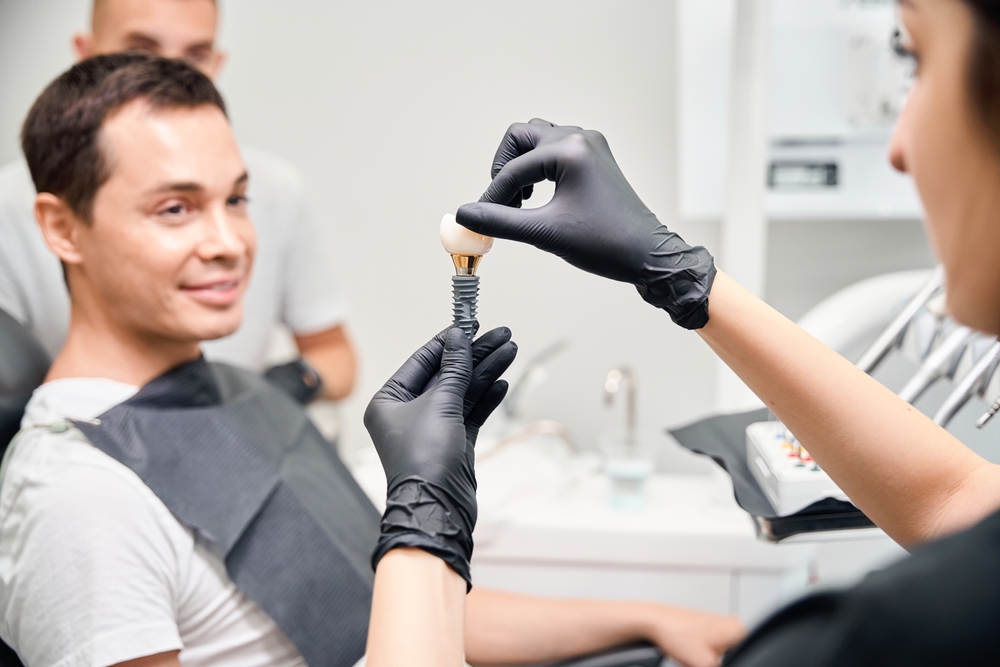
On surgery day, the team thoroughly numbs the area and places the titanium post into the prepared site in your jaw. Most patients are surprised by how quick and manageable the appointment feels compared to what they expected. Afterward, the real work happens quietly over the following weeks as the post fuses with the surrounding bone, a process called osseointegration.
Caring for Your Implant During Recovery
Healing at home is simple: keep brushing, keep flossing, and avoid tobacco products while the bone and post bond. A little tenderness in the first several days is typical and usually settles with basic over-the-counter pain relief. Since healing happens under the gumline, your visible routine looks pretty much the same as it always has.
Completing Your Smile With a Custom Crown
Once imaging confirms the implant has fully integrated, you’ll come in to have your permanent crown attached, designed to blend seamlessly with the rest of your smile. Dr. Yazdanmehr fine-tunes the bite before you leave so the new tooth feels balanced against the rest of your mouth. After that, your implant simply joins your regular six-month exam schedule.
What happens if you do nothing?
Financial Implications of Waiting Too Long
Acting at the right time leads to a simpler, less costly path to your final restoration. Socket preservation at the time of extraction is a straightforward procedure that protects the bone and prepares the site for a future implant. Missing that window often means more extensive grafting later, adding procedures, healing time, and cost.
Supporting Citation/Source
The long-term numbers back this up. A 30-year cost-utility analysis comparing implant-supported crowns and fixed bridges found implant treatment carried lower cumulative costs over three decades, roughly $6,422 for an implant-supported crown versus $8,398 for a three-unit bridge, once ongoing maintenance and complications were factored in. The bridge’s higher long-term cost came largely from more frequent retreatment.
Health Implications of an Untreated Missing Tooth
A missing tooth left in place doesn’t just sit there quietly. Chewing shifts to other teeth, wear patterns change, and the gap becomes harder to keep clean, raising the odds of nearby decay or gum disease. Left unresolved for years, these changes add up to a restorative case far more involved than the original tooth ever was.
Research on tooth movement after extraction confirms this. A three-dimensional imaging study tracking adjacent tooth drift after premolar extraction found neighboring molars and canines consistently tipped and drifted toward the open space, mostly tilting mesially. That drift compounds over time, narrowing the space and complicating future restoration.
Safety Implications of Delayed Treatment
Postponing treatment while bone loss advances changes the surgery itself. What would have been a routine implant placement into healthy bone can turn into a case requiring a sinus lift or substantial grafting, procedures that take longer and carry a higher chance of complications during healing.
Data on sinus lift procedures illustrate this well. A systematic review evaluating complication rates after sinus floor elevation found issues like postoperative sinusitis or partial graft failure affecting up to 38% of patients, with implant failure in up to 17% of cases within three years. Straightforward placement into preserved bone carries a meaningfully lower risk.


Get Started With Dental Implants Mission Valley Care!
Ready to talk about Dental implants Mission Valley patients trust for a complete, comfortable smile? Dr. Shawn Yazdanmehr handles your consultation, surgery, and final restoration personally, so you work with one dentist throughout. Follow along on Facebook and Instagram to get a feel for the practice, then reach out to schedule your visit.
FAQs
How many appointments does dental implant treatment take?
Most implant treatment plans move through three main stages: a consultation, implant placement, and a final visit for your crown. Straightforward cases can finish in three to four dental visits total, though additional appointments may be needed for bone grafting or socket preservation. Dr. Yazdanmehr maps out the full timeline for implant dentistry patients in Mission Valley before treatment starts, so nothing catches you off guard.
Will a dental implant look natural?
Yes, a dental implant is designed to blend in completely with the rest of your smile. Only the porcelain crown is visible above the gumline, shaped and shaded to match your surrounding teeth so it isn’t obvious you’re wearing an artificial tooth. Because the artificial root sits below the gum, the cosmetic benefits stay consistent for years with nothing more than routine oral hygiene.
Can dental implants help with jawbone loss?
Yes. Unlike a bridge or denture, a dental implant replaces the missing tooth’s root, which stimulates the jawbone the same way a natural root does. That stimulation helps prevent the jawbone loss that follows tooth loss and protects the facial muscles that rely on that bone for support. Patients who replace a missing tooth early typically preserve more bone than those who wait.
How do I take care of my dental implant long term?
Long-term care for a dental implant looks a lot like caring for your natural teeth. Brush twice daily, floss around the implant, and keep up with regular dental checkups and exams so you catch small changes early. Post-operative follow-up care during healing matters too, since good habits early on support a stronger, longer-lasting result. Beyond that, no special products or removal are required.
What's the difference between a single implant and an implant-supported bridge?
A single implant replaces one missing tooth with its own titanium post and crown, while an implant-supported bridge uses two or more implants to anchor a span of replacement teeth across a wider gap. Both protect your remaining natural teeth from being reshaped, unlike a traditional bridge. The right option depends on how many teeth you’re missing and the condition of your jawbone.