
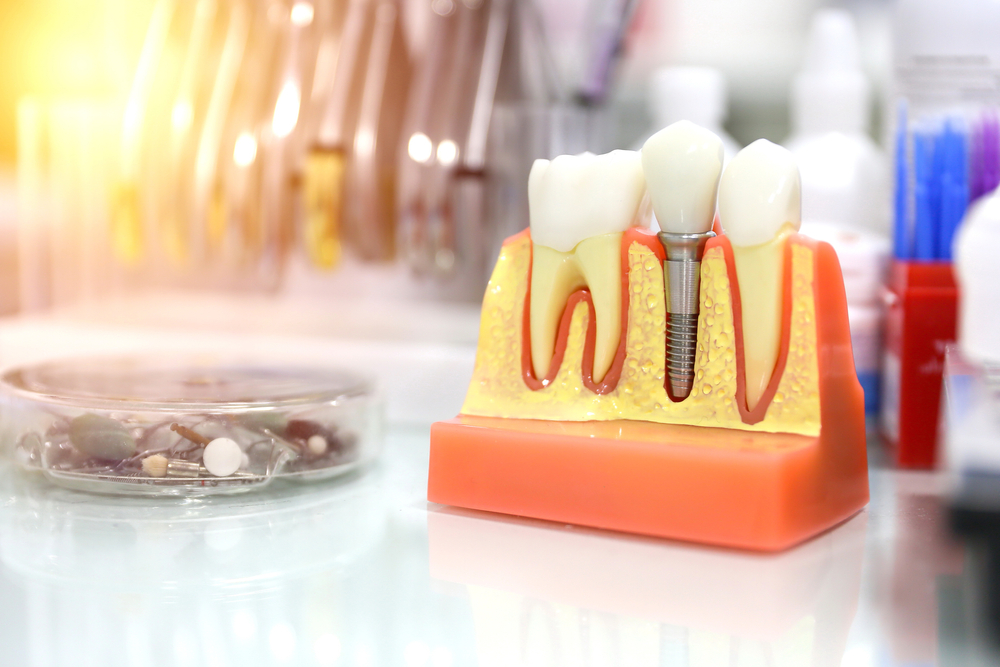
Dental implants La Mesa patients search for more than a way to close a gap. They should restore how you eat, speak, and feel about your smile. A dental implant is a metal post, typically titanium, that fuses with your jawbone through osseointegration, forming a stable base for a crown, bridge, or denture. Left untreated, tooth loss causes bone resorption, dental shifting, and ties to systemic disease beyond your mouth. At Salt and Smile Dental Co., Dr. Shawn Yazdanmehr manages every stage himself, so your care never passes between different providers.
Dental Implants La Mesa


Meet Dr. Shawn Yazdanmehr
Dr. Shawn Yazdanmehr grew up in Carlsbad, studied pre-dentistry at UCLA, and earned his dental degree from the University of the Pacific, Arthur A. Dugoni School of Dentistry. After several years practicing in Chicago, he returned to San Diego to lead Salt and Smile Dental Co. His work centers on precise dental procedures: dental implants, socket preservation, bone grafting, and crowns and bridges. Patients work with him at every stage, from consultation through final crown, with no handoffs between providers.
Are you experiencing the effects of missing teeth?
Is a dental implant right for you?
If you’re missing one or more teeth, or you know a tooth can’t be saved, you’re likely weighing your options carefully. The questions below help you think through whether dental implants make sense for your situation. We’ll cover candidacy, the process, timing, and how implants compare to other treatments. By the end, you should have a clearer picture of what fits your dental needs.


Types of Dental Implants We Offer
Single Tooth Implants
A single tooth implant replaces one missing tooth with a titanium post anchored in the jaw and a custom crown on top. The teeth on either side stay completely untouched, the defining advantage over a traditional bridge. Dr. Yazdanmehr’s focus on crowns and bridges carries directly into this work. The crown requires the same precision in fit, bite alignment, and color matching as any other restoration.
A systematic review found single-tooth implants had a 95.5% survival rate one year after loading, with average marginal bone loss of just 0.20 mm. Survival dipped closer to 92% under certain immediate-loading protocols, which is why personalized care matters more than any general statistic.
Implant-Supported Dentures
Implant-supported dentures anchor a removable denture to two to four implants placed in the jaw. The denture snaps into place, providing far more stability than a conventional denture that relies on adhesive or suction alone. Patients missing most or all of the teeth in an arch, who want more security than a traditional denture without the cost of a fixed restoration, are often well-suited here.
Snap-in dentures meaningfully improve stability, eating and speaking confidence, and bone preservation compared with traditional dentures, at a lower cost than a full fixed arch. The trade-offs matter too: the denture is still removed nightly for cleaning, and bone changes over time can affect the fit. One study found that only 1.7% of conventional denture wearers felt very satisfied with denture stability, compared with 44.8% of implant-overdenture patients.
All-on-Four Dental Implants
All-on-4 implants are available for patients who’ve lost all their teeth in an arch, or are facing that outcome due to failing dentition. Four implants, two vertical near the front and two angled toward the back, support a complete fixed arch. The angled placement uses denser rear bone, often avoiding the need for grafting even with some existing bone loss.
All-on-four implants deliver a fixed, non-removable result no conventional denture can match, restoring full chewing function when patients maintain hygiene and keep up with follow-up visits. It’s the highest-cost implant option, involves surgery at multiple sites, and some patients need pre-treatment before qualifying. A long-term study found implant survival rates of 97.4% in the upper jaw and 98.9% in the lower jaw over 17 years, though the upper jaw carried a meaningfully higher failure risk. That distinction is worth factoring into any individual treatment plan.

What to Expect During Your Dental Implant Treatment
A Thorough Exam Before Any Treatment Begins
Your treatment starts with a dental consultation with Dr. Shawn Yazdanmehr, DDS, who reviews your dental history and examines your gum health in detail. He’ll take imaging to evaluate your jawbone structure and confirm you have enough bone volume for a titanium post. If a tooth still needs to come out, he’ll talk through extraction and socket preservation as part of the exam. Any dental anxiety gets addressed directly here, before anything is scheduled.
Mapping Out Your Implant Options and Timeline
No two smiles need the same approach, so your dental treatment plan is built around your bone volume, dental needs, and long-term goals. Dr. Yazdanmehr walks through which option fits best, whether that’s a single implant, implant-supported bridges, or a full-arch solution. He’ll also flag whether you need bone grafting first, since that changes your overall timeline. You’ll leave this step knowing exactly what to expect, and roughly how long each stage will take.
Surgical Implant Placement, Explained
When you’re ready to move forward, Dr. Yazdanmehr places the titanium post directly into the jawbone during a straightforward in-office procedure. Local anesthesia keeps you comfortable throughout, and most patients describe the appointment as far easier than they expected. The implant then needs time to bond with the surrounding bone tissue before any restoration goes on top. This bonding process, called osseointegration, gives your implant long-term stability.
What Recovery Looks Like After Implant Placement
Caring for a dental implant during healing doesn’t require any special products or routines. Brushing twice daily, flossing once a day, and avoiding tobacco all support successful integration with the bone. Some mild soreness in the days following placement is normal and manageable with over-the-counter pain relief. Because the implant is healing beneath the gum, your day-to-day dental hygiene stays close to what you already do for natural teeth.
Attaching Your Final Crown
Once healing is confirmed, you’ll return for your final restoration, and Dr. Yazdanmehr attaches your custom-crafted crown or bridge. Every crown matches the size, shape, and color of your surrounding teeth for a natural result. From there, follow-up visits and routine oral fitness checks help catch issues early, like a bite adjustment or early signs of gum disease. This ongoing relationship is what keeps implant care here from ending the moment treatment does.
What happens if you do nothing?
Financial Implications
Choosing not to replace a missing tooth may feel like avoiding an expense, but the cost usually moves the other way over time. Bone loss that progresses without treatment often requires grafting before you can place an implant. A patient who could have had a single implant early may later need a full mouth reconstruction instead. Each added stage of complexity adds cost that early treatment would have avoided.
A 30-year cost-utility analysis found that an implant-supported crown was less costly and more effective over time than a comparable three-unit fixed bridge, largely because bridges need more retreatment over a lifetime. Waiting rarely saves money in dentistry; it usually just adds procedures. Early implant treatment is often the more predictable, budget-friendly path.
Health Implications
Untreated tooth loss sets off changes that reach well beyond the visible gap. The jawbone resorbs without a root’s stimulation, and adjacent teeth drift into the space, disrupting your bite. Chewing efficiency drops, which can affect food choices and nutrition over time. The exposed site also becomes harder to clean, increasing the risk of nearby gum disease.
The connection between oral health and the rest of the body is well documented. Research from the National Institute of Dental and Craniofacial Research found that people with diabetes are roughly 15 times more likely to have lost all of their teeth than those without. Untreated tooth loss and the bone deterioration that follows don’t stay confined to the mouth. They interact with, and can worsen, systemic disease elsewhere in the body.
Safety Implications
As bone density drops and oral health declines, the surgical complexity of eventual treatment increases. Procedures that are straightforward with adequate bone become more involved once significant resorption has occurred. Retained failing roots can become a persistent source of infection affecting nearby tissue and bone.
Retained infection carries measurable risk. A 12-year review found that systemic complications occurred in 3.8% of patients hospitalized for odontogenic infections, with hospitalization rates for these infections rising over time. A failing root or unresolved extraction site can plausibly cause that kind of infection. That’s one more reason unaddressed tooth loss deserves attention sooner rather than later. Treating the site early avoids that risk altogether.

Make Dental Implants La Mesa Care Part of Your Plan
Dental implants La Mesa patients’ trust starts with a real conversation, not a sales pitch. That’s what Dr. Shawn Yazdanmehr and the team at Salt and Smile Dental Co. provide. We guide you through every stage for a comfortable, natural-looking smile, from your first consultation to your final crown. Follow us on Facebook and Instagram to see our work before your visit. When you’re ready, request your consultation today.
FAQs
How long do dental implants last?
The titanium post that integrates with the jawbone can last a lifetime with consistent oral hygiene and regular dental care. The crown placed on top is subject to normal wear over years of use and may eventually need to be replaced, though this varies by patient. Habits like teeth grinding, oral hygiene consistency, and overall health all affect how well the full restoration holds up over time. Most patients who take care of their implants go decades without needing any changes to the post itself.
Does getting a dental implant hurt?
The placement procedure is performed under local anesthesia so that you won’t feel pain during the surgery. Some soreness and swelling in the days following placement is normal and manageable with over-the-counter pain relief in most cases. Dr. Yazdanmehr prioritizes patient comfort throughout the process and takes time to explain each step before it happens. Patients who come in anxious about the procedure frequently find the experience more manageable than they anticipated.
What is socket preservation, and why does it matter for implants?
Socket preservation is a procedure performed at the time of a tooth extraction. The dentist places bone graft material into the empty socket immediately after the tooth is removed to help maintain bone volume and shape for a future implant. Without it, the bone in that area begins to shrink relatively quickly, which can complicate later implant placement. Patients who know they want an implant later still benefit from socket preservation now, since it protects the site for future treatment.
Can I get dental implants if I've already lost bone in my jaw?
Bone loss doesn’t automatically disqualify you from implant treatment. Bone grafting, which is performed in-office at Salt and Smile Dental Co., can rebuild lost volume and create a more suitable foundation for an implant post. How much grafting is needed, and whether it’ll be sufficient to support an implant, depends on the extent and location of the bone loss. Many patients who assumed they weren’t candidates find that grafting opens the path to treatment.
How is an all-on-4 implant different from a traditional denture?
A traditional denture rests on the gum tissue and relies on adhesive or suction to stay in place. It can shift while eating or speaking, and it does nothing to prevent the bone loss that occurs when teeth are missing. All-on-4 dental implants anchor a fixed arch of teeth directly to four implants placed in the jaw. The result doesn’t come out, doesn’t require adhesive, and the implants help preserve the bone beneath them. For patients with full tooth loss or who are tired of a traditional denture, the functional difference is substantial.